

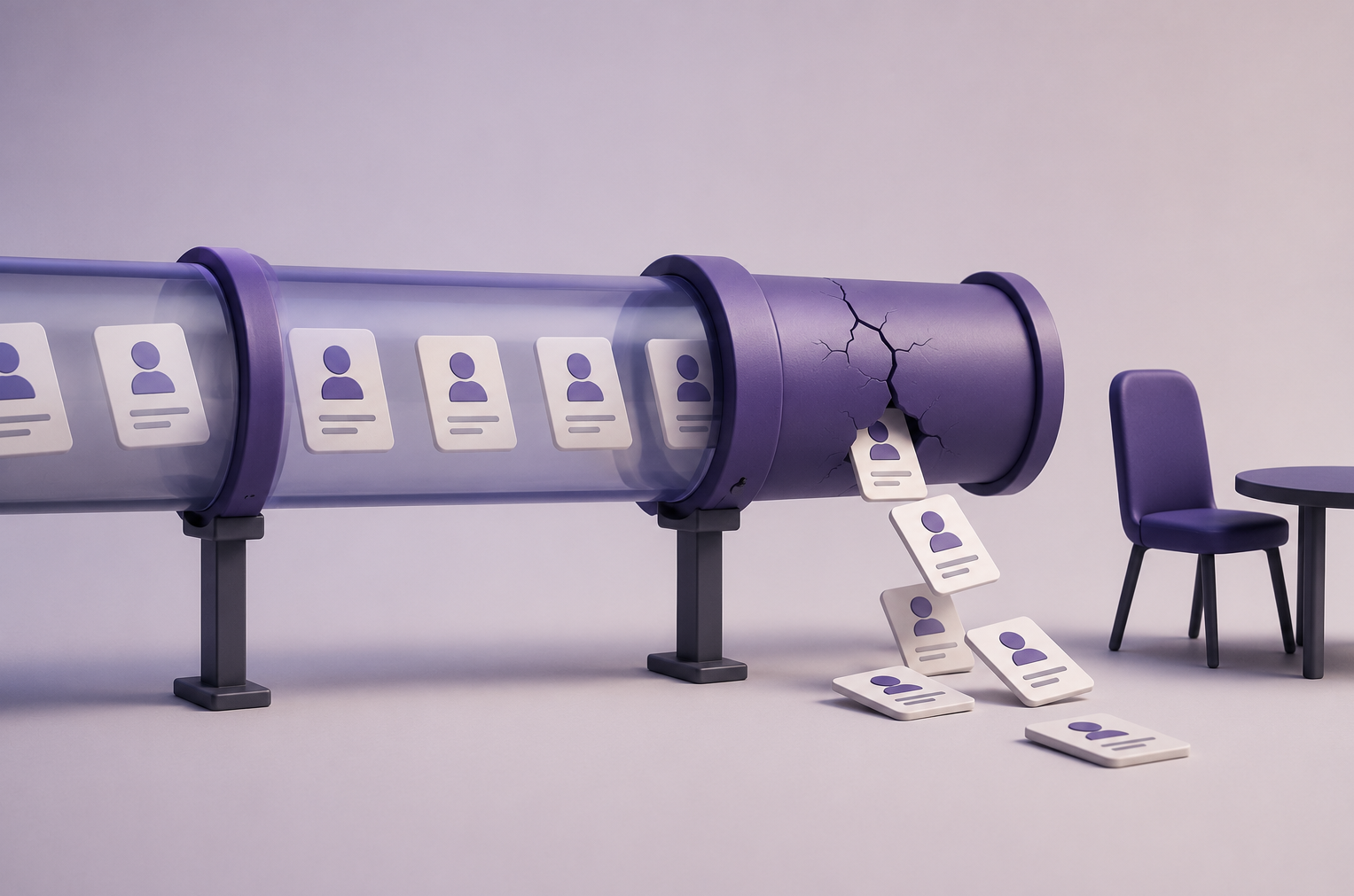
By the time a candidate reaches the interview stage, the employer has already spent money finding them, screened the resume, and sent an invitation. Very little of what happens next gets tracked. And this is the stage where the best candidates walk. Up to 32% of hiring managers name the interview stage as the biggest source of candidate loss in their pipeline, per the iCIMS 2025 State of Frontline Hiring Report, ahead of scheduling (20%), onboarding (18%), and application (14%).
The Drop-Off No One Tracks
Measurement is part of the problem. Most hiring dashboards track the top of the funnel closely. Teams know how many job ads went live, how many applications came in, and how long the process took to reach an offer. However, fewer teams track where in the process candidates actually walked away.
The interview stage is named as the biggest drop-off point more than twice as often as the application stage. Although recruiters have spent years shortening applications and adding pay transparency, the same effort has not gone into what happens after the application lands.
Three Patterns
Three patterns explain most of the drop-off, and they compound each other. Scheduling causes the most.
Scheduling delay
Ashby's 2025 Talent Trends Report found that applications per hire have tripled since 2021. Teams handle more volume with fewer people, and calendar coordination has become a bottleneck. The average time-to-hire is now 41 to 44 days. Strong candidates read a two-week scheduling gap as a signal that the role is low priority, and they accept whichever offer arrives first.
Not knowing what to prepare for
Candidates rarely know what an interview will actually test. The typical briefing materials are a calendar invite and a job description, so the candidate does not know if they will face a panel, a case study, a technical exercise, or an open conversation. That uncertainty reduces their confidence in the employer, and for candidates with options, it makes them like the employer less.
The wrong screening format
Async video screening tools are common now. Many ask candidates to record timed answers to generic questions with no clear reviewer and no connection to the actual work of the role, and candidates who have done this before know it is not useful to either side. Research in Humanities and Social Sciences Communications in 2025 found that AI-enabled interview formats can lead applicants to withdraw before being hired, especially when the format feels unfair.
The Financial Cost
Each of these frictions has a dollar cost. SHRM's 2025 Benchmarking Report puts the average cost-per-hire for non-executive roles in the US at $5,475. That number covers sourcing, recruiter time, job board spend, screening, and coordination, all of it spent before the interview is scheduled. A candidate who exits at the interview stage takes that money with them.
For a team running 50 open roles in a year, dozens of candidates are lost per cycle, each representing $5,475 already spent. There is also vacancy cost, the revenue or productivity loss from an unfilled seat, and every candidate who exits and forces a restart makes that vacancy longer.
The interview stage is where the employer's investment runs highest and where candidate patience runs shortest.
The Best-Qualified Pool
The candidates who walk at this stage are often the best-qualified ones. CareerPlug's 2025 Recruiting Metrics Report, which covers over 10 million applications, found that only 3% of applicants reach the interview stage. By the time a candidate gets to that stage, they have already made it through multiple filter layers, and they are the employer's best-qualified candidates from a much larger applicant pool. That is why hiring managers name this stage as their biggest drop-off problem, even though more candidates numerically leave earlier in the funnel.
This group is the most likely to have competing offers, the most likely to be recruited by other employers, and the most likely to walk when a process feels slow or unclear. Fast offers win in this market.
When an employer loses a candidate at the interview stage, they are losing someone their own screening process already picked as worth advancing.
Three Fixes
Three moves address the causes and start closing the measurement gap.
Set a scheduling commitment. Pick a maximum number of days between accepting an application and the first interview step, then measure whether the team hits it. For most professional roles, 5 to 7 business days from application to first contact is a reasonable target.
Send candidates a process map before any interview begins. A one-paragraph email describing the number of stages, the format of each, the criteria being evaluated, and the expected timeline reduces the uncertainty that drives candidates away.
Make the first screening step reflect the actual work. Generic screening questions do not tell you much about how a candidate would do the job. A short structured task tied to the role, scored against a defined rubric, gives real information about work quality rather than interview polish.
Start Here
The stage employers invest the most in is the stage they measure the least. Closing that gap is where the pipeline stops leaking.
Pull your stage-by-stage drop-off data for the last 90 days. Separate interview-stage withdrawals from rejections. If your tracking system does not distinguish the two, that is the first thing to build.
Works Cited
iCIMS. "2025 State of Frontline Hiring Report." iCIMS, 2025. https://www.pin.com/blog/applicant-drop-off-rates/
Pin. "Cost-Per-Hire: Complete Breakdown and Benchmarks 2026." Pin.com, May 2026. https://www.pin.com/blog/cost-per-hire-benchmarks/
Pin. "Recruitment Funnel Benchmarks 2026: Conversion Rates by Stage." Pin.com, May 2026. https://www.pin.com/blog/recruitment-funnel-benchmarks/
Qin, et al. "Why might AI-enabled interviews reduce candidates' job application intention?" Humanities and Social Sciences Communications, 2025. https://www.nature.com/articles/s41599-025-05607-z
MSH. "Candidate Experience Statistics, Data, & Trends [2026]." Talent MSH, 2026. https://www.talentmsh.com/insights/candidate-experience-statistics