

You see the posting. You like the role. You start reading the requirements, and then you get to the line that says "include a short video response". You close the tab. You tell yourself you will come back to it later. You never come back.
You are not the only one. Most candidates do this. Most candidates do this because most candidates hold a set of beliefs about video that, once measured against reality, turn out to be wrong.
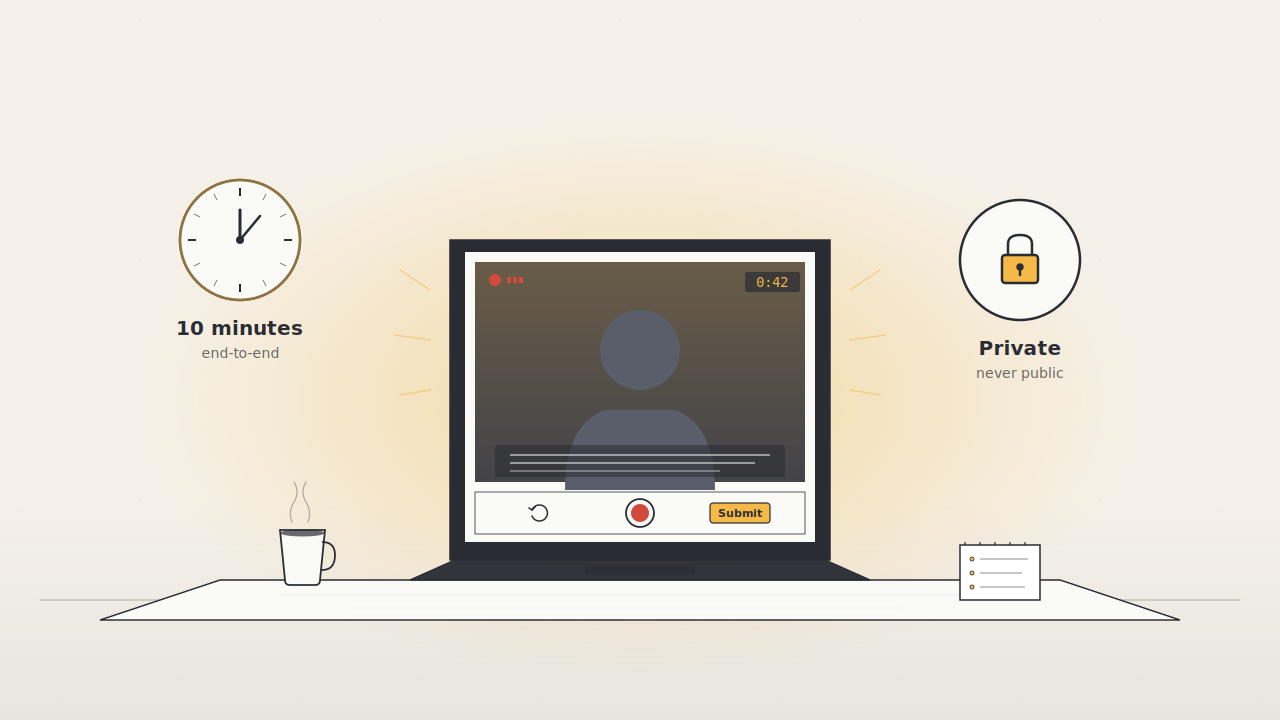
This post measures three of those beliefs against reality. The fear that video takes too long. The fear that video exposes you publicly. The fear that video has to be perfect. Each of those fears is real, each of those fears is common, and each of those fears is beatable with about ten minutes of understanding.
Fear One: Video Takes Too Long
Ask a candidate how long a video response will take, and the answer is usually 45 minutes to an hour. Ask a candidate how long a well-written cover letter takes, and the answer is usually 30 to 60 minutes. Those estimates look roughly similar. Watch a candidate actually do each one, and the numbers tell a different story.
A tailored cover letter involves reading the posting closely, drafting the letter, revising the letter, proofreading the letter, reformatting the letter for the application system, and hoping the application system does not strip the formatting. The median time, in our observation, is 35 to 50 minutes per role. The quality variance is wide, the process is solitary, and the result is a document that a hiring manager may or may not read. Eye-tracking research has shown that an initial recruiter review of a resume or cover letter can be as brief as 7.4 seconds, and more recent surveys report that roughly 81 percent of recruiters spend less than a minute on an initial screen (Tegze).
A two-minute video response, recorded with a teleprompter, with unlimited retakes, with the question provided in advance, takes roughly this long:
Two minutes to read the question and think about the answer. Two minutes to outline the three points you want to make. Two minutes to record the first take. Two minutes to record a second take if the first felt off. Two minutes to submit. Total: about ten minutes.
One of our colleagues recently tested the McCoy platform as a candidate, timed every step, and reported the full application ran twenty minutes. The twenty minutes included creating a fake persona from scratch for testing purposes, using AI to generate a resume for the fake persona, and improvising answers in a voice that was not her own. She estimated that a real candidate, using a real resume, answering authentically, would finish in about ten minutes, with roughly two of those minutes spent on the actual video.
Ten minutes is a small investment for an application that will be differentiated, memorable, and much harder to confuse with any other submission in the stack.
Fear Two: Video Exposes You Publicly
The second fear runs deep. A video feels permanent. It feels searchable. It feels like the one piece of your application that could be screenshotted, shared, or mocked if it lands wrong.
The fear is reasonable when the video lives on a public feed. The fear is misplaced when the video is a private response delivered only to the hiring employer.
A private video response is exactly that: private. The video does not appear on any public feed. The video is not searchable by strangers. The video is not shared with anyone other than the employer reviewing your application. The video is, in effect, an attached file with your voice and face on it, visible to the same small set of people who would read your cover letter.
Candidates who have been burned by public-facing content (a viral post that misfired, a comment that got screenshotted, a professional photo that spread further than planned) are often surprised to learn that a private video response carries none of those risks. Candidates who have been hesitant to post on public feeds because "going viral" feels like exposure rather than opportunity often find that a private response channel is a comfortable fit.
The short version: if you are comfortable sending a PDF resume to a specific employer, you can be comfortable sending a private video to the same employer. The audience is the same. The consequences are the same. The surface area is the same.
Fear Three: Video Has To Be Perfect
This fear is the quiet one, the one candidates do not say out loud. Am I going to look okay? Am I going to sound okay? Do I need to set up a ring light? Do I need to rearrange my apartment? Do I need to rehearse until the answer is memorized word for word?
The answer to all of those questions is no.
Hiring managers reviewing video responses have told us, consistently, what they are looking for: clarity of thought, authenticity of voice, and the ability to communicate a specific answer to a specific question. They are not looking for a Hollywood production. They are not grading your lighting. They are not evaluating your camera angle. They are looking for a human answering their question in a way that feels real.
A slightly imperfect video, recorded in a normal living room, by a candidate who sounds like a thoughtful person thinking through a question, outperforms a polished, over-rehearsed performance almost every time. The imperfections are not the obstacle. The imperfections are the signal that a real person showed up.
Permission, restated: you do not need to look like a news anchor. You do not need a studio. You do not need to memorize the answer. You need to answer the question, clearly, in your own voice, in two minutes or less.
A Ten-Minute Walkthrough
Here is how a ten-minute video application actually runs.
Minute one. Read the role posting. Read the question the employer is asking. Think about the answer for a moment.
Minutes two and three. Jot down three points. The first point is your main answer. The second point is a short example that grounds the main answer in something you have actually done. The third point is a sentence about why you care about this work.
Minute four. Open the response tool. Check your camera, check your audio, check the teleprompter if you are using one.
Minutes five and six. Record the first take. Two minutes, three points, done. If it feels off, record a second take.
Minute seven. Watch the take you want to submit. Make sure the audio is clean. Make sure you finished your sentences.
Minutes eight through ten. Submit. Move on with your day.
That is the entire process. The fear that it takes an hour is a fear created by not having done it yet. The fear dissolves on contact with the actual ten minutes.
The Competitive Advantage Hiding In Your Discomfort
A quick strategic note before the close. The fact that video feels hard is, for a candidate who decides to do it anyway, a significant advantage. Industry estimates put current application volume at roughly 250 applications per posting, and as high as 400 for entry-level roles, much of it AI-generated ("2026 Job Application Statistics"; Morris). A candidate who completes a short video response is competing in a field that has already shrunk by an order of magnitude. Your application will stand out by the simple fact of existing.
The discomfort is the filter. The filter is working in your favor once you walk through it.
The Role of McCoy
McCoy was built around this specific set of fears. The platform provides a teleprompter so you do not have to memorize the answer. McCoy AI asks you questions to draw out personal experiences that could answer the question effectively. The platform allows unlimited retakes so the first take does not have to be perfect. The platform delivers the video privately to the hiring employer so it never appears on a public feed. The platform generates role-specific follow-up questions so your response is calibrated to what the employer actually wants to know.
You can respond to a McCoy role in about ten minutes. Two of those minutes will be on camera. The other eight will be thinking, outlining, and submitting.
The door opens faster than you think, and opens wider than you think, and stays open for the candidate who shows up.
Three Quick Questions
How long does a video job application really take? About ten minutes end-to-end, including roughly two minutes of actual recording. The rest is reading the question, outlining your answer, and submitting.
Will my video be posted publicly? No. A private video response goes only to the hiring employer. It does not appear on any public feed, and strangers cannot search for it.
Do I need professional equipment to record a video response? No. Your phone or laptop camera is fine. Employers are looking for clarity and authenticity, not production quality.
McCoy makes video responses simple, private, and fast. If you are ready to stand out on your next application, visit McCoyIQ.com.
Works Cited
Morris, Chris. "Why AI Resumes Are Overwhelming Recruiters and Managers." Inc., inc.com/chris-morris/ai-resumes-overwhelming-recruiters-managers/91207016.
Tegze, Jan. "How Long Do Recruiters Spend Reviewing a Resume?" LinkedIn, linkedin.com/pulse/how-long-do-recruiters-look-resume-jan-tegze-1e.
"2026 Job Application Statistics." HiringThing Blog, HiringThing, blog.hiringthing.com/job-application-statistics.two-minute-video-applicatio