

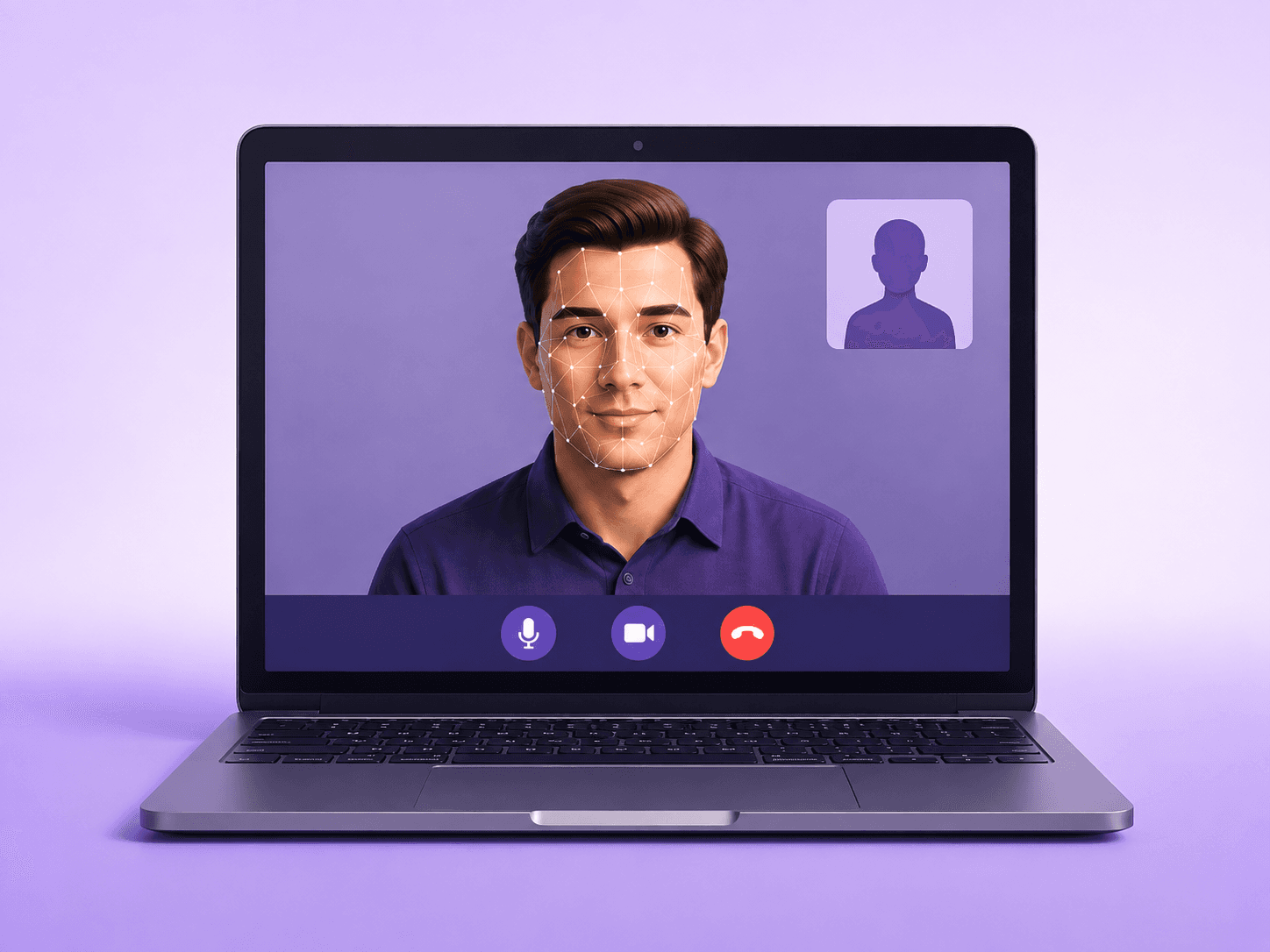
One of the questions we hear most often is what to do about deepfakes. Real-time deepfakes have moved from a curiosity to a real problem in hiring, and companies are reacting with some strange interview tactics. "Pan the camera around the room." "Wave a hand in front of your face." "Hold both hands in the air while the question is read". The Wall Street Journal recently catalogued this new wave of reality tests.
It's cheaper and easier than you'd think to create a deepfake. A security team at Palo Alto Networks showed that a single researcher with no image-editing experience and a five-year-old computer could build a synthetic interview identity in about 70 minutes that can sit through a live interview and answer in real time.
Inside a deepfake interview
During the interview, three pieces of technology run at once. A real-time face-swap model paints a synthetic face over the live video. A voice-cloning layer replaces the speaker's voice. And an answer generator listens to each question and feeds polished responses to the live person behind the mask.
All three technologies feed into the video call through a central virtual camera, a piece of software that presents itself to a browser or video call application as if it were an ordinary webcam. The virtual camera aims to spoof a real webcam, so the interviewing software cannot tell the difference between a physical sensor and a program piping in the deepfake feed.
Gartner predicts that by 2028, one in four job-candidate profiles worldwide will be fake. The same Wall Street Journal reporting found that 59% of managers already suspect candidates of using AI to misrepresent themselves during hiring. In one extreme case, operatives working for North Korea used real-time deepfakes to get hired into Western companies and reach their systems and their payroll.
The desktop is the weak point
In a remote interview the candidate joins from their own computer. The company cannot install inspection software on a stranger's machine, and a browser video call only receives the finished video stream. The browser sandbox is designed to stop a website from auditing your drivers or spotting a virtual camera in the first place.
A determined faker can even feed a manipulated stream through a small hardware capture device that the operating system reads as a genuine webcam. So the company is left with whatever it can do from its own side of the call, which is why it asks people to wave their hands. A live face-swap still tends to glitch when a hand crosses the face, because the model cannot reconstruct what is behind it fast enough.
Video submissions suffer from the same weakness
Some companies ask applicants to submit a recorded, asynchronous video with their application, and on an ordinary webcam that is an even easier target than a live interview. No one is on the other end, so there are no curveballs, no interviewer asking you to turn your head, wave a hand in front of your face, or hold up an ID, and the faker controls every variable. Retakes, editing, and other post-processing can clean up any glitches. The rendering does not even have to run in real time. A live deepfake has to keep pace at 30 frames a second, which caps its quality, while a recorded clip can be rendered slowly, frame by frame, at far higher fidelity.
Every one of those advantages depends on the same thing, the faker controlling the camera feed, which is exactly what a browser hands them. Change how the video is captured and the whole approach falls apart, which is where mobile comes in.
Native mobile apps can be a solution
On iPhone, the virtual-camera route is effectively closed. When a native app requests the camera through the standard system tools, it receives the actual hardware sensor. There is no user-installable virtual camera on iOS that can feed a fake stream into a third-party app the way desktop software does. The plug-and-play deepfake has nowhere to plug in.
Android is more open, but the bar is far higher. To inject a fake feed you generally have to root the device or run an emulator with a virtual-camera module, and both of those states are detectable. Apple's App Attest and Android's Play Integrity let an app confirm it is running on a genuine, untampered device rather than a rooted phone or an emulator, which are exactly the environments where injection becomes possible.
None of this is bulletproof. A faker can still point a phone at a second screen playing a deepfake, or have a different real person record the answer, which is impersonation rather than a deepfake. But both are clumsier, easier to notice, and far less scalable than downloading a virtual camera onto a laptop.
A remote video interview is no longer proof that a real, consistent person is on the other end, and hand-waving tests are a stopgap. Capturing a candidate's response through a native mobile app removes the one attack anyone can run in 70 minutes and forces the rest down to routes that are slow, awkward, and much easier to spot.
Works Cited
Bindley, Katherine. "Employers Are Making Job Candidates Jump Through Hoops to Prove They're Real." The Wall Street Journal, 30 Aug. 2026. https://www.wsj.com/lifestyle/careers/remote-job-interview-applications-fraud-c9022cbe
"By 2028, 1 in 4 Candidate Profiles Will Be Fake, Gartner Predicts." HR Dive, 2025. https://www.hrdive.com/news/fake-job-candidates-ai/757126/
Unit 42. "False Face: Unit 42 Demonstrates the Alarming Ease of Synthetic Identity Creation." Palo Alto Networks, 2025. https://unit42.paloaltonetworks.com/north-korean-synthetic-identity-creation/
"North Korean Operatives Use Deepfakes in IT Job Interviews." Dark Reading, 2025. https://www.darkreading.com/remote-workforce/north-korean-operatives-deepfakes-it-job-interviews