

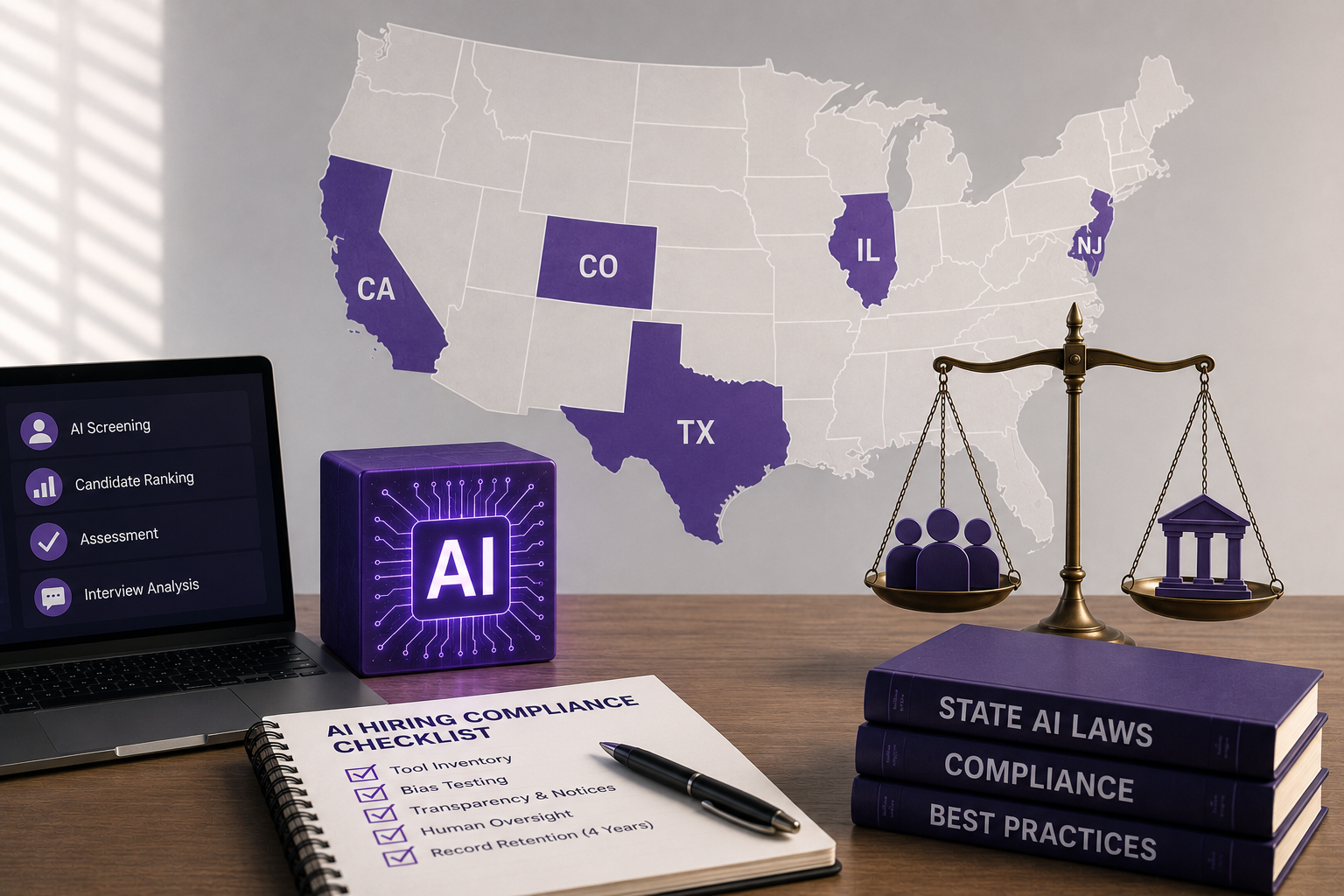
California, Texas, Illinois, New Jersey, and Colorado have all now passed AI hiring laws. Together, those five states represent roughly a third of US GDP and host the country's biggest hubs in tech, finance, energy, and pharma. If your company hires across the US, you almost certainly touch at least one of them. SHRM's State of AI in HR 2026 report puts current AI adoption in HR functions at 39%, with recruiting the most common application. The compliance question is no longer hypothetical for a multi-state employer.
The five states have now moved from legislative intent to active obligation. Each has distinct triggers, distinct recordkeeping demands, and distinct enforcement mechanisms. The compliance question is no longer whether these laws apply. It is which frameworks your current workflow is out of alignment with, and by how much.
The Gap That Precedes All Five Frameworks
Before the jurisdiction-by-jurisdiction checklist, two structural gaps deserve attention.
The first is geographic scope. Several of these laws reach employers headquartered outside the state. If your company produces a product or service used by residents of one of these states, or deploys an AI tool that affects workers based there, the law may apply regardless of where your HR team sits.
The second gap is vendor accountability. Through administrative guidance issued in January 2025 and regulations finalized in December 2025, the New Jersey Attorney General and Division on Civil Rights confirmed that AI tools are not a shield against liability under the state's Law Against Discrimination. The guidance clarified that the New Jersey Law Against Discrimination (NJLAD) applies to algorithmic discrimination resulting from the use of automated decision-making tools, including tools purchased from third parties.
New Jersey is explicit on this point, but the principle holds across every framework in this post.
The employer who outsources an AI screener owns the outcome of that screener.
Five Jurisdictions, Five Distinct Frameworks
New Jersey
The NJLAD's disparate-impact prohibition is not new. What is new is its explicit application to AI. The regulations, adopted on December 15, 2025, apply to all employers operating in New Jersey and otherwise subject to the NJLAD, including multistate employers with New Jersey-based roles or applicants. They confirm the NJLAD's prohibition of facially neutral employment policies or practices that disproportionately harm a protected class, even absent discriminatory intent.
A formal disclosure mandate to candidates is not yet in the statute, but the New Jersey Attorney General's Civil Rights Innovation Lab is actively monitoring employer AI use. Enforcement does not wait for explicit rulemaking to begin.
What the employer must do: Audit any AI screening, ranking, or scoring tool for disparate impact on protected classes. Require vendors to produce validation documentation, bias-testing results, and training data descriptions before deployment.
Illinois
House Bill 3773 amended the Illinois Human Rights Act and took effect on January 1, 2026. It requires employers to notify employees and applicants when using AI during recruitment, hiring, promotion, renewal of employment, selection for training or apprenticeship, discharge, discipline, tenure, or when the use could affect the terms, privileges, or conditions of employment.
The Illinois Department of Human Rights draft implementing rules, labeled Subpart J, extend this to any instance where AI "influences or facilitates" a covered employment decision, whether or not the outcome is discriminatory. Recordkeeping obligations require employers to preserve AI-related notices and records for 4 years.
What the employer must do: Post and distribute an AI notice in the formats the Illinois Department of Human Rights will specify. Document every employment decision touched by an AI tool. Retain those records for 4 years from the date of each covered decision. Using ZIP codes as a proxy for protected classes in AI-driven decisions is also explicitly prohibited.
Texas
The Texas Responsible Artificial Intelligence Governance Act (TRAIGA), signed June 22, 2025, took effect January 1, 2026. Texas chose a narrower liability framework than the other states in this post. TRAIGA bans intentional AI discrimination but does not treat statistical disparate impact as a standalone basis for liability, which is a meaningful departure from the New Jersey and California approaches.
The state attorney general has exclusive enforcement power, and employers receive a notice and a 60-day cure period before penalties take effect. TRAIGA establishes a tiered penalty structure, with fines scaling by whether a violation is curable and whether it continues after notice.
What the employer must do: Maintain documentation sufficient to explain what any deployed AI system does, what data trained it, and what outputs it produces. The attorney general's online complaint portal goes live by September 1, 2026. That is the date enforcement pressure meaningfully increases. Prepare before it.
California
The California Civil Rights Council's Employment Regulations Regarding Automated-Decision Systems took effect on October 1, 2025. They interpret California's Fair Employment and Housing Act (FEHA) to prohibit any automated-decision system that creates a discriminatory adverse impact, whether or not the discrimination was intentional. These regulations are designed to prevent discrimination based on characteristics protected by FEHA, including situations where AI tools create an unlawful adverse impact. In addition to expanding potential liability, the regulations significantly increase recordkeeping obligations, requiring employers to preserve certain records and data for at least 4 years.
California's regulations also make the absence of anti-bias testing an affirmative liability signal in discrimination claims. An employer who tested a tool before deployment and retained documentation of that testing is in a materially better legal position than one who did not.
What the employer must do: Conduct anti-bias testing before deploying any new automated-decision tool. Implement meaningful human oversight over any AI-assisted employment decision. Retain all automated-decision system input and output data for 4 years per applicant interaction.
Colorado
Colorado's trajectory illustrates how rapidly this landscape can shift. The original Colorado Artificial Intelligence Act (SB 24-205) never took effect. A replacement law, Senate Bill 26-189, was signed on May 14, 2026 and takes effect on January 1, 2027. It requires deployers to notify candidates when covered automated decision-making technology influences a consequential employment decision, explain adverse outcomes within 30 days, and offer meaningful human review. The Colorado Attorney General holds exclusive enforcement authority.
What the employer must do: Map which AI tools in the hiring workflow materially influence who advances or is rejected. Distinguish procedural tools, such as scheduling systems, from decision-influencing tools, such as ranking engines or scoring models. Build a pre-use notice and an adverse-outcome explanation process before January 1, 2027.
The Common Thread Across All Five
Despite the variation in structure and liability theory, three obligations appear across every framework:
Inventory your AI tools. Every framework presupposes that the employer knows which systems influence employment decisions. Applicant tracking system integrations, ranking plugins, and video analysis features embedded in third-party products all potentially qualify. That inventory does not build itself.
Retain records for 4 years. California requires it explicitly for automated-decision system data. Illinois requires it for AI-related disclosures. New Jersey's disparate-impact defense depends on it. Texas's attorney general can demand it on investigation.
Establish human review over adverse outcomes. Colorado, California, and New Jersey each require some form of human override or review pathway. A documented escalation process, accessible to any candidate who requests it, satisfies the core requirement across all three frameworks.
There is also a harder obligation fewer employers have addressed: being able to explain, in plain terms, what a given AI tool evaluated and why the output looks the way it does. Tools that produce a numerical score or ranking without a human-readable rationale are the most difficult to defend across every framework on this list.
What About New York?
New York is the most economically significant state without an active AI hiring law, but that may not last. The New York AI Act (S011692), introduced in January 2025, would regulate "consequential decisions" made by AI systems, including in employment. If enacted, it would impose risk management requirements, annual impact assessments, public disclosure obligations, an applicant's right to opt out, and a private right of action allowing applicants to sue.
The bill is still in committee, but New York City has had a related local law in effect since 2023. Local Law 144 requires annual independent bias audits of automated employment decision tools used to screen candidates for jobs based in NYC. Any employer hiring into a New York City role is already operating under that obligation, separate from anything the state legislature does.
Which Law Applies When? A Note on Conflict of Laws
The hardest compliance question is not what any single state requires. It is which state's law applies when a candidate sits in one state, the role is based in another, the employer is headquartered in a third, and the application's terms of service name the law of a fourth.
This is a doctrine called Conflict of Laws, and it is genuinely complicated. Courts weigh multiple factors: where the candidate experienced the alleged harm, where the work would be performed, where the employer is incorporated, and what the contract says about jurisdiction. Choice-of-law clauses in application terms of service are not a clean shield. Courts will often refuse to enforce them when a different state has a stronger public interest in protecting its residents, which is frequently the case in employment matters.
A practical rule for multi-state employers: comply with the strictest, most restrictive applicable framework across the states you hire into. If California requires four-year recordkeeping and Texas requires only that you maintain documentation on request, build to California's standard for every applicant. This avoids the trap of having to defend a choice-of-law argument in each individual case.
Before implementing any specific protocol or policy meant to satisfy multi-state compliance, consult employment counsel familiar with the specific jurisdictions you operate in. Conflict-of-laws analysis is fact-specific and the wrong call here is the kind that produces a multi-year discovery fight.
This article is general commentary and does not constitute legal advice. Employers facing specific compliance questions should consult qualified counsel.
Works Cited
SHRM. "The State of AI in HR 2026 Report." Society for Human Resource Management, 2026. https://www.shrm.org/topics-tools/research/state-of-ai-hr-2026/full-report
Jackson Lewis. "NJ's New Disparate Impact Rules Reinforce Employers' Need for Antidiscrimination Vigilance." Jackson Lewis, March 2, 2026. https://www.jacksonlewis.com/insights/njs-new-disparate-impact-rules-reinforce-employers-need-antidiscrimination-vigilance
Fisher Phillips. "Top 10 Employer Takeaways as New Jersey Cracks Down on AI Discrimination." Fisher Phillips, January 2025. https://www.fisherphillips.com/en/insights/insights/top-10-employer-takeaways-as-new-jersey-cracks-down-on-ai-discrimination
K&L Gates / National Law Review. "Illinois Anti-Discrimination Law to Address AI Goes Into Effect 1 January 2026." National Law Review, 2026. https://natlawreview.com/article/illinois-anti-discrimination-law-address-ai-goes-effect-1-january-2026
Duane Morris. "Texas' AI Law Is Now in Effect — What Employers Need to Know About TRAIGA 2.0." Duane Morris, May 27, 2026. https://www.duanemorris.com/alerts/texas_new_ai_law_is_now_in_effect_what_employers_need_to_know_about_traiga2_0526.html
Thompson Coburn. "California's New AI Bias Rules: What Employers Need to Know." Thompson Coburn, March 17, 2026. https://www.thompsoncoburn.com/insights/californias-new-ai-bias-rules-what-employers-need-to-know/
California Civil Rights Council. "Civil Rights Council Secures Approval for Regulations to Protect Against Employment Discrimination Related to Artificial Intelligence." CRD, June 30, 2025. https://calcivilrights.ca.gov/2025/06/30/civil-rights-council-secures-approval-for-regulations-to-protect-against-employment-discrimination-related-to-artificial-intelligence/
Colorado General Assembly. "SB 26-189 — Automated Decision-Making Technology." Colorado General Assembly, May 14, 2026. https://leg.colorado.gov/bills/sb26-189
Reinhart Boerner Van Deuren. "Illinois Employers Face AI Transparency Deadline Despite New Executive Order." Reinhart Law, December 18, 2025. https://www.reinhartlaw.com/news-insights/illinois-employers-face-ai-transparency-deadline-despite-new-executive-order
AI Laws by State. "AI Hiring Laws by State 2026: Compliance Map." AI Laws by State, April 25, 2026. https://www.ailawsbystate.com/blog/ai-hiring-laws-by-state-compliance-map
K&L Gates. "Q1 2025 New York Artificial Intelligence Developments: What Employers Should Know About Proposed and Passed AI Legislation." K&L Gates, April 22, 2025. https://www.klgates.com/Q1-2025-New-York-Artificial-Intelligence-Developments-What-Employers-Should-Know-About-Proposed-and-Passed-AI-Legislation-4-22-2025