

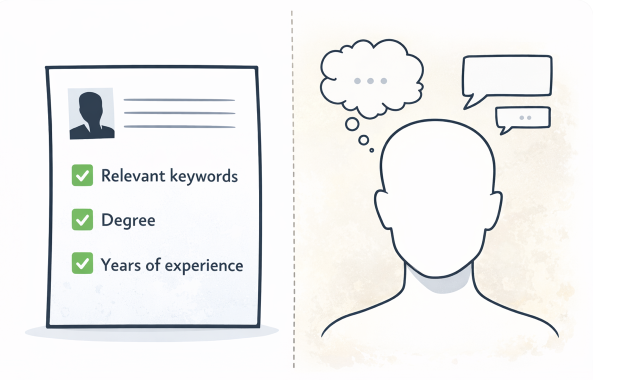
You spend forty-five minutes tailoring your resume. You study the job description. You mirror the language, hit the keywords, optimize for the parsing algorithms that you've read will filter your application within milliseconds. You format it perfectly — no fancy fonts, no graphics, clean bullet points, reverse chronological order. You paste it into the application system, hit submit, and then you wait. Three days later, a rejection email arrives. You never spoke to a human. You never had a chance. The algorithm decided in 0.3 seconds that you didn't match, and your forty-five minutes of optimization meant nothing.
This is the job search in 2026, and it's broken.
According to Select Software Reviews' 2026 analysis, 88% of employers believe they're losing highly qualified candidates to their own ATS systems, and 76% of recruiters expect to replace their primary recruiting system within 12–24 months. In July 2025, Indeed and Glassdoor cut 1,300 workers as parent company Recruit Holdings pivoted to AI, acknowledging that the old model of matching resumes to job descriptions is obsolete. The irony is sharp: the very companies that created the ATS problem are now running away from it.
The ATS was built for a world that no longer exists. Building your career strategy around beating an algorithm is like studying for a test the school already canceled — and the professionals who stop playing the ATS game first will have a massive advantage.
What the ATS Actually Is
Start with what the ATS actually is — not what you've been told it is. The Applicant Tracking System was never designed to find talent. It was designed to manage volume.
In the early 2000s, when companies were drowning in paper applications, an ATS was a lifesaver. It could parse PDFs, extract keywords, sort candidates into tiers, and reduce chaos to something manageable. But it was architecturally obsolete the moment the problem changed.
Now:
Applications have doubled since 2022
The average job posting attracts 250 applications
Only 4 to 6 are interviewed
The ATS is supposed to identify those 4 to 6 from the 250. Instead, it's blocking qualified candidates and letting in the noise. And it can't filter AI-generated applications — someone can now use AI to generate a perfectly optimized resume in twelve minutes. Eighty-eight percent of employers admit they're losing good people to their own systems. That's not a software bug — that's a system that has become the problem it was designed to solve.
The Lie at the Center of the "Beat the ATS" Industry
There's a deeper problem with the entire "beat the ATS" industry, and it starts with a lie.
The statistic that everyone quotes — that 75% of applications never get read by a human — came from a sales pitch by a company called Preptel in 2012. Preptel was selling ATS optimization services, and they published this number as evidence that ATSs were filtering out good candidates. The problem: there was no methodology. No audit. No actual research backing the claim. Preptel went bankrupt a year later, but the statistic survived. It spread.
An entire industry of resume optimization services, interview prep companies, and LinkedIn coaches built their entire business model on a fabricated statistic from a defunct company.
You're optimizing your resume for an algorithm based on a lie told in 2012 to sell software that no longer works. Worse, the more you optimize for the ATS, the more you sound like the AI-generated applications that the ATS can't filter out. You're becoming indistinguishable from the noise you're competing against. That's a losing game.
What to Do Instead
What to do instead is almost embarrassingly simple: stop optimizing for algorithms and invest in human connection.
Find the hiring manager on LinkedIn
Send a personalized message
Mention something specific about the company or the problem they're solving
Do this for fifteen companies that genuinely interest you — not two hundred companies you've never heard of
A candidate targeted fifteen companies with genuine, personalized video outreach and landed four interviews in three weeks. Not because they were more qualified than the resume-tailoring job seeker, but because they skipped the game entirely. They went around the algorithm.
When a hiring manager gets a message that says "I've been following what you're doing, and I think I can help with X," you're not a candidate in a pile — you're a person the hiring manager is already thinking about. That's the advantage no ATS optimization can give you.
The forty-five minutes you would have spent tailoring your resume for ATS keywords? Spend that time researching the company. Spend it recording a two-minute video that shows your personality and your thinking. Spend it writing a genuine message to a human being.
The people who make this shift first — who stop playing the dead man's game and start building human connections — are going to have such an unfair advantage that they'll barely remember what the application portal looked like.