

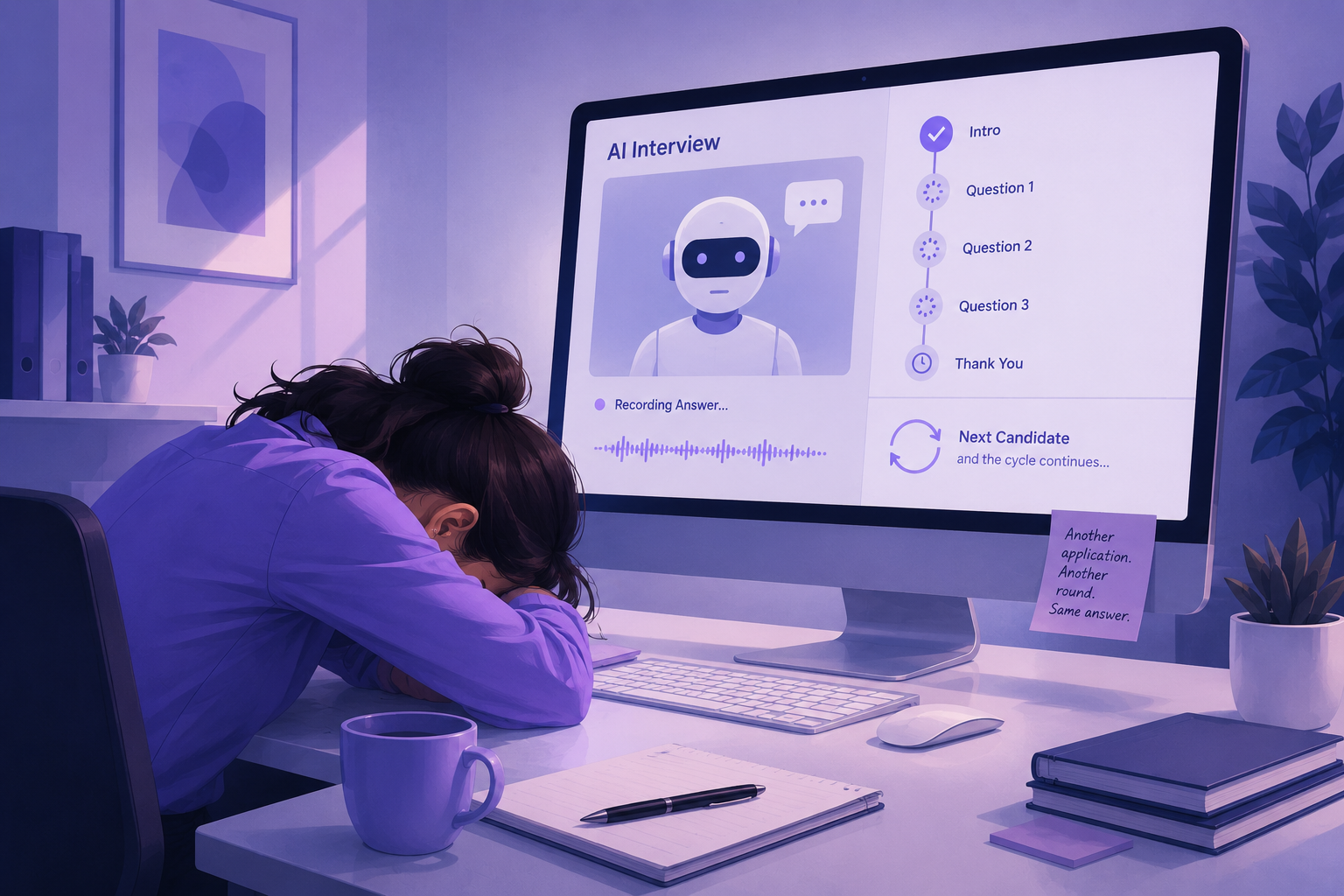
Almost 4 in 10 job candidates have already withdrawn from a hiring process because an AI interview was required. Another 12% say they will. That finding sits inside Greenhouse's 2026 Candidate AI Interview Report, released in May, and it deserves more attention than it has gotten. Most coverage of AI in hiring fixates on the employer side. The candidate side is now refusing to participate.
The pattern matters because it is happening at the exact moment employers feel most pressured to automate the early funnel. LinkedIn now sees an average of 11,000 applications per minute, a 45% jump in a year. 67% of HR leaders told Robert Half in March that AI-generated applications have slowed their hiring, with 1 in 5 reporting delays of more than 2 weeks. The natural response is to point AI at the inbound flood. The unnatural consequence is that the strongest candidates start opting out.
Nobody seriously expects companies or candidates to stop using AI. The real question is what the AI is replacing, and what it is supporting.
Why AI Interviews Actually Feel Bad
Greenhouse's chief people officer called the resulting candidate experience "an arms race, not a hiring process," and said candidates were reacting to "a feeling of being processed rather than considered." That diagnosis matches what shows up on the candidate side. Four things happen at once when a candidate sits down for an AI-only interview round, and any one of them is enough to make a strong candidate close the tab.
A high-pressure conversation with a robot. The natural rhythms that make an interview feel like a conversation are gone. There is no nod, no follow-up question, no read of the room. The candidate is performing into a void, and the void is grading them.
No control or transparency. The candidate does not know what the AI is measuring. They do not know what happens to the recording. They do not know whether the model is biased against an accent, a pause, a phrase. The asymmetry is total. The company knows everything about what they want. The candidate knows nothing about what is being evaluated.
One-sided and self-serving by design. The company saves the recruiter's time. The candidate spends their evening. The benefit travels in one direction. The candidate notices.
The conversational energy is gone. Good interviews are partly an exchange of energy. The candidate's enthusiasm sharpens when the interviewer leans in. The interviewer's interest sharpens when the candidate says something unexpected. An AI interview removes both halves of that feedback loop. The candidate is talking into a microphone, alone, with no signal coming back.
A candidate adding those four reactions together arrives at a single conclusion.
The company is solving for its own time, not theirs. The candidate is doing free labor with no return.
The strongest candidates, the ones with options, leave at that point. The funnel records silence.
What the Doom Loop Actually Is
The walkout is not a one-off reaction to bad UX. It is the candidate's response to a structural pattern Greenhouse CEO Daniel Chait named late last year.
Job seekers use AI to apply at scale. Employers use AI to filter the scale. Filters fire on automated signal, so candidates lean harder on the tools that produce automated signal. Volume goes up. Differentiation goes down. Both sides invest more energy and end up with worse outcomes than they had before either side automated anything.
In a normal market, one side disengages and the loop breaks. In hiring, neither side can afford to. Employers cannot stop screening. Candidates cannot stop applying. So both sides keep escalating, and the part of the process that used to carry real signal, the conversation between two people about a real role, gets squeezed thinner every quarter.
Chait described it more bluntly than most executives are willing to. He said it was the first time in his 14 years running an ATS company that both sides were unhappy at the same time. That observation is the news. Employers being frustrated is not new. Candidates being frustrated is not new. Both, simultaneously, at scale, with both sides losing trust in the process, is new.
The Employer's Side of the Story
Before going further, the employer's logic deserves to be stated straightforwardly. The employer flooded with 11,000 applications a minute is not lazy or careless. The employer is staring down a volume problem that did not exist five years ago, and an AI screening tool is the only resource that scales with the inbound rate. From inside that view, an AI interview round is not a substitute for a conversation. It is the only way to triage a pipeline that would otherwise drown the recruiter.
That logic is real. It is also incomplete. The candidate sitting on the other end of that AI interview is not weighing the recruiter's volume problem. They are weighing how the round made them feel, and they are deciding whether the company is worth their time.
What Candidates Are Really Asking For
The report's most useful finding is the one that contradicts the AI-versus-humans framing the coverage usually reaches for. Only 19% of candidates told Greenhouse they want less AI in hiring. The majority want the same or more, with guardrails.
The guardrails they named are not exotic.
44% want to be told upfront that AI will evaluate them
39% want a clear explanation of what the AI is measuring
46% want the option to request a human interview instead
Today, 70% of candidates are never told ahead of time that AI is involved. 1 in 5 only discover it after the interview has started.
Candidates are not asking for an AI-free process. They are asking for AI that respects them.
What AI Done Right Looks Like
If the four failures above are the diagnosis, the inverse is the design. A hiring process that uses AI well looks like five specific things, all of which invert the AI-interview pattern.
Low pressure. The candidate is not performing under a stopwatch into a camera that grades them. The AI works around the candidate, not at them.
Control and transparency. The candidate knows what AI is involved, what it is evaluating, and what happens to their recording. The asymmetry that makes an AI interview feel like surveillance is replaced with information the candidate can act on.
Benefit for both sides. The recruiter saves time. The candidate saves time too. The candidate gets faster responses, clearer expectations, and a process that respects the hours they are investing. The benefit travels in both directions.
Enhances conversation rather than replacing it. AI prepares the ground for a human to make a better decision faster. It does not stand in for the human. The candidate still gets the human exchange that interviews are supposed to be.
Not 100% of the experience. Real human touchpoints, real human judgement, and real human conversation stay inside the process at the points where they matter. The AI is the assistant, not the interviewer.
Few tools are doing this. Most products in the market still treat AI as a replacement for human conversation rather than a support layer around it. That gap is exactly where the walkout numbers are pointing.
Works Cited
Greenhouse Software. "63% of Job Seekers Have Faced an AI Interview. Most Haven't Had a Good One Yet." PR Newswire, May 2026. https://www.prnewswire.com/news-releases/63-of-job-seekers-have-faced-an-ai-interview-most-havent-had-a-good-one-yet-302760120.html
HR Dive. "Job candidates say they're quitting the hiring process over AI interviews." HR Dive, May 2026. https://www.hrdive.com/news/job-seekers-walk-away-from-AI-interviews/819443/
Fortune. "Nearly 4 in 10 job candidates have bailed on a hiring round because it required an AI interview." Fortune, May 4, 2026. https://fortune.com/2026/05/04/4-in-10-job-candidates-bailed-hiring-rounds-required-ai-interview/
Fortune. "Trust is at an all-time low for both job seekers and recruiters: Hiring platform CEO says talent acquisition is in an AI doom loop." Fortune, November 18, 2025. https://fortune.com/2025/11/18/hiring-job-seekers-recruiters-talent-acquisition-ai-doom-loop-application-technology/
Robert Half. "Robert Half survey: 67% of HR leaders report AI-generated applications are slowing hiring." PR Newswire, March 10, 2026. https://www.prnewswire.com/news-releases/robert-half-survey-67-of-hr-leaders-report-ai-generated-applications-are-slowing-hiring-302709410.html