

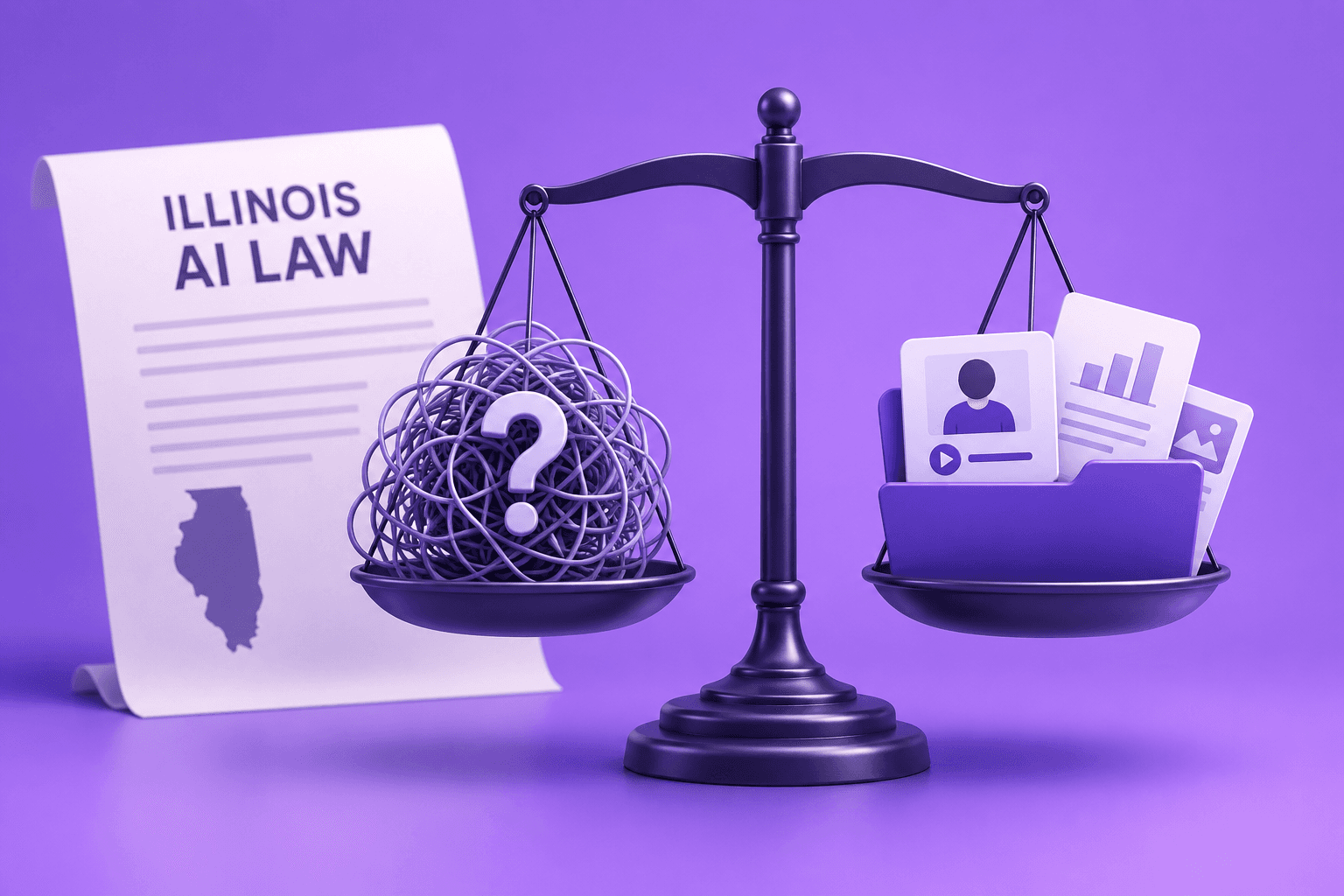
In August of 2024, Governor J.B. Pritzker signed into law for the State of Illinois HB 3773, Public Act 103-0804, which was to take effect January 1, 2026. Briefly, HB 3773 amends the Illinois Human Rights Act to require employers to provide notice to employees when any artificial intelligence technology (“AI”) is used in covered employment decisions. It similarly prohibits use of zip codes as a proxy for protected classes in AI-driven processes. It also reinforces that employers may not use AI in a manner that results in discrimination on the basis of any existing protected class under Illinois law.
However, despite the law taking effect on January 1, 2026, many employers who utilize video screening technologies in Illinois have not yet updated their notice practices, a potential civil rights violation under the Illinois Human Rights Act. Many have been awaiting guidance from the Illinois Department of Human Rights (“IDHR”) on proposed rulemaking. IDHR published proposed rules on May 15, 2026, then withdrew them “to further consult and collaborate with other State agencies.” 56 Ill. Adm. Code 2520, proposed at 50 Ill. Reg. 6794 (May 15, 2026), withdrawn (June 26, 2026). No rules are in force, IDHR has announced no revised timeline, and the statutory obligations have applied since January 1, 2026.
Illinois Began Regulating AI Video Interviews in 2020
Illinois did not begin regulating AI in hiring with HB 3773. The Artificial Intelligence Video Interview Act, 820 ILCS 42, took effect January 1, 2020. It requires an employer using AI analysis of applicant-submitted videos to “[n]otify each applicant before the interview,” to “[p]rovide each applicant with information before the interview explaining how the artificial intelligence works and what general types of characteristics it uses to evaluate applicants,” and to “[o]btain, before the interview, consent from the applicant.” 820 ILCS 42/5. An employer “may not use artificial intelligence to evaluate applicants who have not consented.” Id.
What HB 3773 Requires Now
The operative provision is 775 ILCS 5/2-102(L), which makes it a civil rights violation:
“(1) With respect to recruitment, hiring, promotion, renewal of employment, selection for training or apprenticeship, discharge, discipline, tenure, or the terms, privileges, or conditions of employment, for an employer to use artificial intelligence that has the effect of subjecting employees to discrimination on the basis of protected classes under this Article or to use zip codes as a proxy for protected classes under this Article.
(2) For an employer to fail to provide notice to an employee that the employer is using artificial intelligence for the purposes described in paragraph (1).”
“Artificial intelligence” means “a machine-based system that, for explicit or implicit objectives, infers, from the input it receives, how to generate outputs such as predictions, content, recommendations, or decisions that can influence physical or virtual environments.” 775 ILCS 5/2-101(N). That definition would likely reach employers using video interview analysis to effectuate any of the enumerated decisions, although only a court can resolve it.
The statute delegates the mechanics: “The Department shall adopt any rules necessary for the implementation and enforcement of this subdivision, including … the circumstances and conditions that require notice, the time period for providing notice, and the means for providing notice.” Id. The duty is statutory. The timing, the form, and the triggering conditions are the rules IDHR withdrew.
Effect Alone Triggers Liability
Section 2-102(L)(1) reaches AI “that has the effect of subjecting employees to discrimination.” The word “intent” does not appear. On the face of the text, an employer would likely face liability without regard to whether it intended the effect, whether it built the tool, or whether it understands it.
No Illinois court has construed subsection (L), and IDHR has published no guidance on it. One potentially illustrative regulatory regime is New Jersey’s. Construing that state’s Law Against Discrimination, the New Jersey Division on Civil Rights has advised that a covered entity “is not shielded from liability for algorithmic discrimination that results from the entity’s use of an automated decision-making tool simply because the tool was developed by a third party or because the entity does not understand the inner workings of the tool.” N.J. Div. on Civil Rights, Guidance on Algorithmic Discrimination and the New Jersey Law Against Discrimination (Jan. 2025). That guidance binds no Illinois tribunal. It does show how one regulator reads effect-based liability where the employer cannot audit the tool.
On finding a violation, the Illinois Human Rights Commission may order actual damages, “reasonable attorney fees and expert witness fees,” and a civil penalty “not exceeding $16,000” absent a prior violation, “not exceeding $42,500” with one prior violation within five years, and “not exceeding $70,000” with two or more within seven years, imposed “for each specific act constituting a civil rights violation … and for each aggrieved party injured by the civil rights violation.” 775 ILCS 5/8A-104(K).
Reading the Two Statutes Together
HB 3773 does not mention the AIVIA. It does not amend it, reference it, or repeal it. Illinois courts disfavor repeal by implication, holding that “a later statute general in its terms and not expressly repealing the prior special statute will ordinarily not affect the special provisions of the earlier statute.” People ex rel. Madigan v. Burge, 2014 IL 115635, ¶ 32 (quoting People ex rel. Atwell Printing & Binding Co. v. Board of Comm’rs, 345 Ill. 172, 178 (1931)). The stronger reading is that the statutes are cumulative. The AIVIA governs the interview and requires consent. Section 2-102(L) governs the decision and requires notice. The AIVIA protects “applicants,” while section 2-102(L)(2) speaks of an “employee.” The AIVIA never defines artificial intelligence, and it supplies no penalty and no express private right of action.
What Employers Must Record, and What BIPA Adds
Recordkeeping is narrow. Under 820 ILCS 42/20, an employer “that relies solely upon an artificial intelligence analysis of a video interview to determine whether an applicant will be selected for an in-person interview must collect and report” the race and ethnicity of applicants screened and of applicants hired. That data “must be reported to the Department of Commerce and Economic Opportunity annually by December 31.” The agency then reports to the Governor and General Assembly “whether the data discloses a racial bias in the use of artificial intelligence.” Id. The trigger is the word “solely.” An employer whose system advances or rejects candidates with no human review sits inside section 20.
Juxtapose the Biometric Information Privacy Act, 740 ILCS 14, which supplies what the AIVIA lacks. BIPA defines a “biometric identifier” to include a “scan of hand or face geometry,” 740 ILCS 14/10, and affords a private right of action with “liquidated damages of $1,000 or actual damages, whichever is greater,” for a negligent violation and “$5,000 or actual damages, whichever is greater,” for an intentional or reckless one. 740 ILCS 14/20. Whether a screener analyzing facial expressions collects such a scan remains unsettled, and the answer would turn on what the vendor’s technology actually does.
Bot v. Bot Hiring, or Evidence-Based Hiring
Illinois is not an outlier. California’s automated-decision-system regulations took effect October 1, 2025. Cal. Code Regs. tit. 2, § 11008.1 et seq. Texas enacted its AI governance act effective January 1, 2026, on an intent standard. Tex. H.B. 149 (2025). New York City has required bias audits and candidate notice since 2023. N.Y.C. Admin. Code § 20-870 et seq. Four of the six largest state labor markets now regulate AI in hiring, on inconsistent standards.
The harder question is whether these tools deliver value proportionate to that exposure. A 2026 audit of three million applicants screened by one vendor’s algorithms found “clear racial disparities in applicant outcomes,” and that, for most groups, “[a]ggregating from individual positions to occupation groups suffices to mask the per-position adverse impact.” Bommasani et al., Algorithmic Monocultures in Hiring, FAccT ’26. The premise of facial analysis has been contested since 2019, when researchers concluded “instances of these emotion categories are NOT expressed with facial movements that are sufficiently reliable and specific across contexts, individuals, and cultures to be considered diagnostic displays of any emotional state.” Barrett et al., Emotional Expressions Reconsidered, 20 Psychol. Sci. Pub. Int. 1 (2019). HireVue discontinued visual analysis in 2021, explaining that “for the significant majority of jobs and industries, visual analysis has far less correlation to job performance than other elements of our algorithmic assessment.” HireVue, Industry Leadership (Jan. 12, 2021).
In Mobley v. Workday, Inc., the court held that “[n]othing in the language of the federal anti-discrimination statutes … distinguishes between delegating functions to an automated agent versus a live human one.” 740 F. Supp. 3d 796, 807 (N.D. Cal. 2024).
The resume has stopped functioning as a reliable signal of what a candidate can actually do on the job. Greenhouse reported that 74% of U.S. job seekers use AI to job hunt, and that 40% have used prompt injection to bypass AI filters. Greenhouse, 2025 AI in Hiring Report (Nov. 19, 2025). Gartner projects that by 2028, one in four candidate profiles worldwide will be fake. Gartner (July 31, 2025). Employers screening AI-generated applications with AI screeners have automated both sides.
Candidates have noticed. Sixty-three percent of U.S. job seekers have been interviewed by AI, 38% have withdrawn from a process because it included one, and 70% of those evaluated by AI were not clearly told AI would be evaluating them. Greenhouse, 2026 Candidate AI Interview Report (May 1, 2026). That last figure states the notice obligation as a market fact.
The response taking shape is evidence-based hiring, which some call trace hiring. Candidates address a defined challenge, they submit work product, and a person scores it against a defined rubric before any ranking is produced. The selection literature supports the design. Structured interviews carry an operational validity of .42 and work sample tests .33, against .19 for unstructured interviews. Sackett et al., Revisiting Meta-Analytic Estimates of Validity in Personnel Selection, 107 J. Applied Psych. 2040 (2022). Requiring evidence up front acts as an organic funnel, and does what the resume no longer does.
Section 20’s trigger is reliance “solely” on AI, and section 2-102(L)(1) reaches AI that “has the effect” of discriminating. A human reviewer scoring candidate work against a rubric narrows the compliance surface and reduces the discrimination risk at once.
The ambiguity is the point. The statute is live, the rules are withdrawn, and the penalties are substantial. An employer who cannot see inside the model can still document the judgment applied to its output.
This article is general commentary and does not constitute legal advice. Employers with specific compliance questions should consult counsel.
McCoy is an evidence-based hiring (i.e., trace hiring) platform that keeps a human in the loop. Eemaan Jalili serves as General Counsel.
Works Cited
Illinois Human Rights Act, 775 ILCS 5/2-101(N), (O) (definitions of “artificial intelligence” and “generative artificial intelligence”); 5/2-102(L) (use of artificial intelligence); 5/8A-104(G), (K) (relief and civil penalties). https://www.ilga.gov/legislation/ilcs/ilcs5.asp?ActID=2266
Public Act 103-0804 (HB 3773), 103d Gen. Assemb. (Ill. 2024) (approved Aug. 9, 2024; eff. Jan. 1, 2026). https://www.ilga.gov/Legislation/PublicActs/View/103-0804
Artificial Intelligence Video Interview Act, 820 ILCS 42/5 (notice, explanation, and consent), 42/15 (destruction of videos), 42/20 (report of demographic data). https://www.ilga.gov/legislation/ilcs/ilcs3.asp?ActID=4015
Biometric Information Privacy Act, 740 ILCS 14/10 (definitions), 14/20 (right of action). https://www.ilga.gov/legislation/ilcs/ilcs3.asp?ActID=3004
Ill. Dep’t of Human Rights, proposed amendments to Procedures of the Department of Human Rights, 56 Ill. Adm. Code 2520, 50 Ill. Reg. 6794 (proposed May 15, 2026), withdrawn (notice published June 26, 2026). Joint Committee on Administrative Rules, Flinn Report, Vol. 50, Issues 20 and 26.
People ex rel. Madigan v. Burge, 2014 IL 115635, ¶ 32 (quoting People ex rel. Atwell Printing & Binding Co. v. Board of Comm’rs, 345 Ill. 172, 178 (1931)).
Mobley v. Workday, Inc., 740 F. Supp. 3d 796, 807 (N.D. Cal. 2024); ADEA collective preliminarily certified May 16, 2025, No. 3:23-cv-00770-RFL (N.D. Cal.), Dkt. 128.
N.J. Div. on Civil Rights, Guidance on Algorithmic Discrimination and the New Jersey Law Against Discrimination (Jan. 2025). https://www.nj.gov/oag/newsreleases25/2025-0108_DCR-Guidance-on-Algorithmic-Discrimination.pdf
Cal. Code Regs. tit. 2, § 11008.1 et seq. (automated-decision systems; eff. Oct. 1, 2025); Tex. H.B. 149, Responsible Artificial Intelligence Governance Act (eff. Jan. 1, 2026); N.Y.C. Admin. Code § 20-870 et seq. (Local Law 144 of 2021; enforcement from July 5, 2023); Conn. Pub. Act 26-15 (Substitute S.B. 5) (approved May 27, 2026; provisions effective Oct. 1, 2026, with deployer notice duties attaching to technologies deployed on or after Oct. 1, 2027).
Bureau of Labor Statistics, State Employment and Unemployment, Table 3 (June 2026 data, released July 21, 2026). https://www.bls.gov/news.release/archives/laus_07212026.htm
Bommasani, R., Bana, S. H., Creel, K. A., Jurafsky, D., & Liang, P., “Algorithmic Monocultures in Hiring,” Proceedings of the 2026 ACM Conference on Fairness, Accountability, and Transparency (FAccT ’26). https://doi.org/10.1145/3805689.3812400
Barrett, L. F., Adolphs, R., Marsella, S., Martinez, A. M., & Pollak, S. D., “Emotional Expressions Reconsidered: Challenges to Inferring Emotion From Human Facial Movements,” Psychological Science in the Public Interest, 20(1), 1–68 (2019). https://doi.org/10.1177/1529100619832930
HireVue, “Industry leadership: New audit results and decision on visual analysis” (Jan. 12, 2021). https://www.hirevue.com/blog/hiring/industry-leadership-new-audit-results-and-decision-on-visual-analysis
Sackett, P. R., Zhang, C., Berry, C. M., & Lievens, F., “Revisiting Meta-Analytic Estimates of Validity in Personnel Selection,” Journal of Applied Psychology, 107(11), 2040–2068 (2022). https://doi.org/10.1037/apl0000994
Greenhouse, 2026 Candidate AI Interview Report (May 1, 2026) (2,950 candidates, including 1,200 U.S. respondents; figures cited are U.S.); Greenhouse, 2025 AI in Hiring Report (Nov. 19, 2025). https://www.greenhouse.com/newsroom
Gartner, “Gartner Survey Shows Just 26% of Job Applicants Trust AI Will Fairly Evaluate Them” (July 31, 2025). https://www.gartner.com/en/newsroom/press-releases/2025-07-31-gartner-survey-shows-just-26-percent-of-job-applicants-trust-ai-will-fairly-evaluate-them