

We were at RecFest USA in Nashville last month, alongside recruiters, talent acquisition leaders, industry thought leaders, and the companies that make recruiting software, from ATSs to sourcing to employer brand and more. The atmosphere was full of camaraderie, and everyone wanted to know how others were dealing with the changes in technology and the hiring process. We felt fortunate to be part of that community.
Across our conversations, the same questions came up again and again. How AI is changing the hiring funnel. Where humans belong in the process. What can be automated and what can't. Which tools have delivered, and which promised to automate something and fell short.
We also spent time with technology companies building for various parts of recruiting:
The vast majority of them talk about using AI in their products:
The patterns below are what we saw in the products themselves. At the end, we share where we think this is heading.
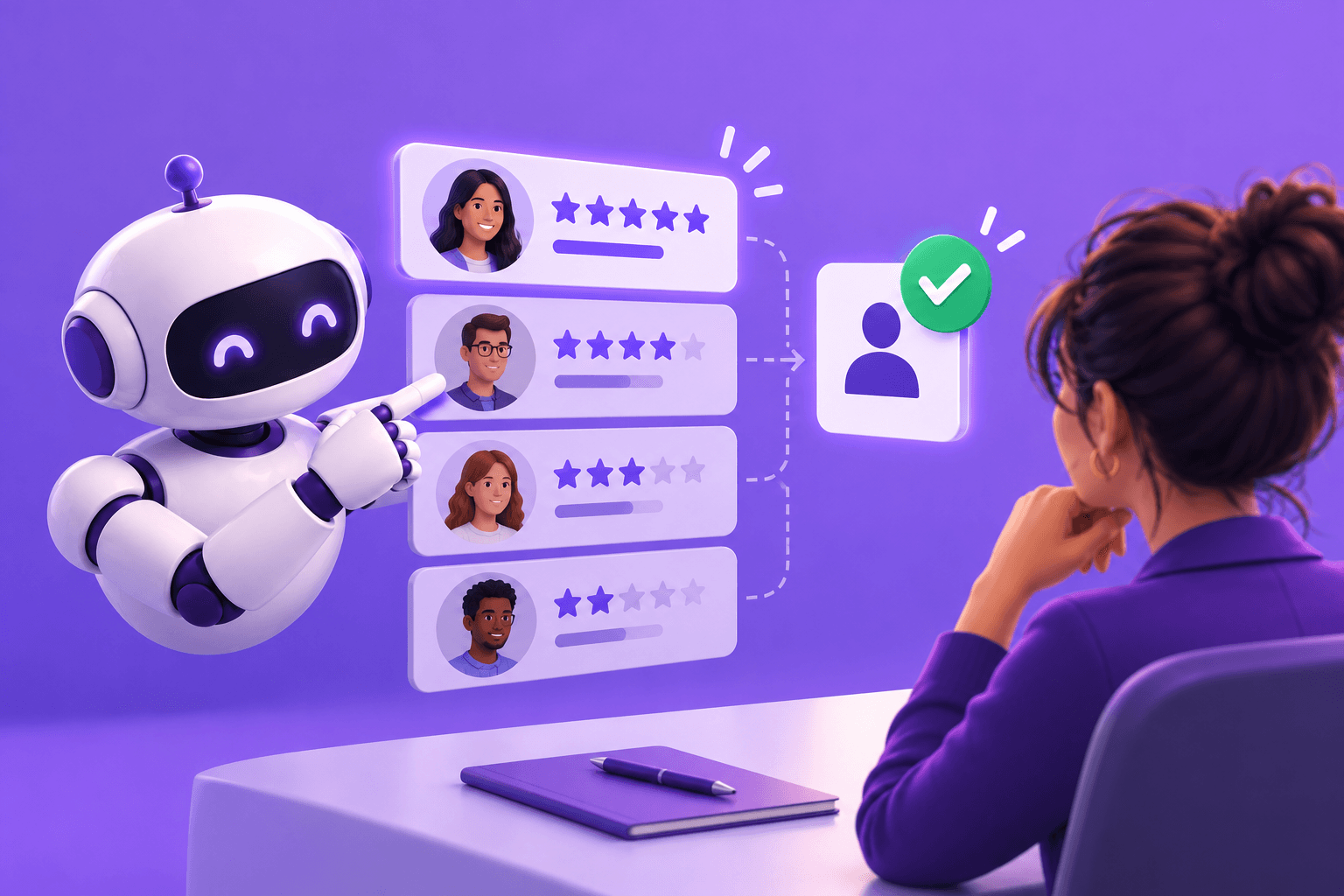
AI ranking is now common
Ranking candidates with AI is now a promise made by ATSs and standalone tools alike. Feed in the applications and the software returns a score, a match percentage, or an ordered list. Two things are unsettled. The first is accuracy. There is little public evidence on how well these rankings predict a good hire, so recruiters mostly take the ordering on faith. The second is regulation, which is still taking shape. New York City has required bias audits of automated hiring tools since 2023, Illinois's HB 3773 took effect in January and covers AI that has a discriminatory effect in hiring, and a federal lawsuit over AI resume screening, Mobley v. Workday, is still in the courts. Many of these companies say specifically that a human needs to sign off on any decision, and how the rules will treat a ranking that a human then acts on is still being worked out.
Pinpoint scores every application against recruiter-set criteria with its AI Match Score, inside the ATS.
Ashby reviews applications against custom criteria with AI-Assisted Application Review, inside the ATS.
SCALIS ships match scoring inside its all-in-one platform.
Cercli built its ATS around Cera, an agent that screens and scores every applicant and advances the qualified ones on its own.
CoderPad ranks candidates with AI in Qualify, its async pre-screen.
Pin says its resume screening automatically evaluates and ranks applicants, from $99 a month.
Broadbean sells machine-intelligence applicant ranking as an add-on to job distribution.
The AI interviewer and the candidate experience
Many recruiting software companies are pushing for automated, full-scale AI interviews with candidates. A common question amongst recruiters is how these affect the candidate experience, and whether they will turn away qualified candidates. In Greenhouse's 2026 survey of nearly 3,000 job seekers, 38% said they had walked away from a hiring process because it required an AI interview, and 38% said a well-run AI interview left them with a better opinion of the company.
Joveo shipped an AI Interviewer in March that runs asynchronous interviews and scores answers against rubrics.
Findem announced its acquisition of Glider AI in March, adding autonomous AI interviews and skills assessments.
Ashby put an AI Interviewer into private beta in May, built on its Talent Llama acquisition.
GoodTime shipped Cori in May, a coordination agent that also screens candidates.
ClearCo released its Agent Platform in June, including a Sourcing Agent that runs AI screening calls and ranks applicants by score.
Criteria announced an AI Interview Agent in June.
Recruitics added Maki People AI voice interviews to its apply flow in June, promising a ranked shortlist.
Metaview launched an AI voice screening agent on September 3 that reviews every call against the same rubric.
Ribbon runs first-round voice interviews around the clock and ranks candidates against custom rubrics, for high-volume employers.
Achilles sells Sam, which interviews hourly and skilled-trades applicants by phone or text within minutes and scores each answer.
Proving the applicant is a real person, start to finish
Fake applications, bots, AI tools that apply on someone's behalf, and now deepfakes have entered the conversation. There are two key questions: Is the applicant an actual person, and is the person who interviewed earlier in the process the same one you end up hiring? Some companies block bots at the apply step. Others verify identity with an ID check. Others watch interviews for signs of an impostor.
Imper launched its workforce identity platform at RSAC in March, analyzing device, network, and location signals across interviews to flag impostors.
Data Facts added biometric ID verification and a tool that alerts employers when a candidate changes pre-populated data mid-application.
Dalia blocks bots and AI auto-apply submissions at the apply step, with SMS verification.
Recruitics added ID.me identity checks to its apply flow in April, then led the July launch of the Open Job Context Protocol, an open standard for applications submitted by AI agents.
Brilliant pairs ID.me verification with fraud detection, and its parent Crosschq ran an invitation-only AI Hiring Fraud Summit in Napa in July.
GoodTime's January hiring report found fraudulent or AI-assisted candidates were the top anticipated hiring challenge for 2026.
Boon's June post argues that AI-generated, look-alike applications are moving budget from job boards and LinkedIn seats toward referrals.
Agentic recruiting, and the parts of the job it can't replace
Agentic recruiting sounds sexy, and it carries a promise that parts of a recruiter's job can be handed to software that runs on its own. Recruiters generally like the idea of cutting down on tedious work such as sourcing searches, outreach sequences, and scheduling. The skepticism starts at decisions. The recruiters we spoke with are reluctant to hand off the human parts of the job like accountability, judgment, intuition, and expertise. The reasons vary. Doubt that it's even possible, concern about bias and about being held accountable for decisions the AI made, and a sense of moral responsibility that humans should be involved. There was also a broader worry among the people we spoke with that AI might replace jobs, and that's probably hard to set aside when evaluating a new product.
Sourcing agents raise a second question, which is data. An agent that searches hundreds of millions of profiles needs those profiles from somewhere, and for many tools that somewhere is LinkedIn, and whether LinkedIn allows it is an open question. A company that builds its own dataset of people, or finds candidates where others don't look, may have something defensible, and from the outside it is hard to tell who does. Automated outreach raises the same question one step later: where the contact information comes from, and what it is like to be on the receiving end of a sourcing conversation with an AI.
Juicebox raised an $80M Series B in March and in May announced agents that source continuously across 800M+ profiles.
SeekOut searches 1B+ profiles for sourcing and outreach, alongside its screening agent.
Pin searches 850M+ profiles, sends automated outreach, and syncs with 120+ ATSs.
Neuroscale's agents source from 900M+ profiles and run outreach before they screen.
ProvenBase looks where the others don't, scanning research publications, patents, and open-source code to find specialized candidates.
ZoomInfo Talent sells verified emails and direct dials for recruiters, built on its go-to-market contact data.
Crelate shipped a Discover Agent for sourcing and an Insights Agent for database enrichment.
Metaview sells its whole product as a set of agents, for notes, sourcing, application review, and screening.
ClearCo named its June release the Agent Platform.
Joveo hosted a dinner during RecFest titled "The Agentic Transformation of Recruiting."
There is still a huge focus on employer brand and attracting applicants
Job advertising, career sites, employer brand, and the agencies that run them still make up a huge part of the industry, and that side is changing too. Candidates now ask a chatbot what a company is like to work for, so employer brand is turning into a question of how a company shows up in AI answers, and the agencies and job boards are starting to sell exactly that.
Built In launched an Employer Intelligence Platform in May that measures how companies appear in AI and search results for job seekers.
HireClix launched a product called JobFlow AEO in April, answer-engine optimization for job listings.
SMRS ran a webinar in September called "The GEO shift," on employer brand visibility in the age of AI.
JobPixel collects short employee videos for employer brand and syncs them to the ATS.
Vouch launched Vouch 3.0 in August 2025, an AI workspace where teams collect and edit employee video stories and surface them on job posts.
Cliquify adds employee-generated video, Video Voices, to its employer brand content platform.
Where this is heading
Easy Apply and AI have created a perfect storm. Not long ago, high application volume was a good thing, as it could easily be dealt with on the backend. Now, a highly tailored resume takes almost no effort, resulting in more noise than ever. Your applicant pool still has qualified candidates. The problem is finding signal in the world's largest haystack.
The common answer in recruiting software is to fight AI with AI. AI interviews, AI screening, AI automation, all promising ease and time savings for recruiting teams. The operations side of the job is genuinely being automated. Monitoring open roles, scheduling, and drafting outreach are tasks recruiters will happily hand to software. Glen Cathey, SVP of Talent Advisory and Digital Strategy at Randstad who also attended RecFest wrote afterward that speakers kept landing on the same conclusion, that the middle of the process is being automated and a recruiter's value is moving to the two ends, deciding what to hire for and who to hire. The other side, deciding who is real and who is worth a conversation, is where most AI tools attempting to deal with volume fall short.
Five hurdles are standing in the way:
Talent teams aren't going anywhere. Although senior leadership believes that hiring is one of the most important functions of an organization, if not the most important, most are not directly involved in the day-to-day hiring process and the tools that support it. Having hiring managers be directly responsible for the hiring process is seen as a distraction from their core job, so companies still hire recruiting staff when budget allows, despite the AI tools on the market. In fact, even the major AI labs are growing their recruiting teams, and the companies selling recruiting agents now say the same thing in their own launches, that the recruiter stays and the agent handles the admin. So medium to large businesses will have dedicated recruiting staff who will be evaluating new software. And the further a product drifts towards replacing human connection and decision-making, the more pushback it gets. Recruiters want help with scale; they do not want to be replaced by AI, nor do they believe that it's actually possible.
Regulation of automated decisions is coming. New laws in Illinois, New York, and California, along with pending lawsuits against Workday and Eightfold, all point toward a future where automated decisions require a human in the loop. If an AI score or ranking decides whether a person gets reviewed by a human, or gets an interview, that is exactly the use the new rules target, and it can expose your company to expensive litigation. The human in the loop these products now advertise is a recruiter clicking approve on a ranked list. Whether regulators and courts treat that click as the decision is the open question.
The input data can't be trusted. A fellow founder at LA Tech Week acknowledged that AI resumes are a major problem, but said AI screeners just haven't gotten good enough to separate the real, quality people from the noise. The trouble with that idea is that as the screeners get better, so do the resumes. The same models are used in both. This is also true of LinkedIn. While LinkedIn is working hard to shut down APIs, prevent automated scrapers, and file lawsuits to punish abuse, its data is deteriorating anyway. A fully built out, polished LinkedIn profile, even one with a few connections in common, no longer settles whether there is a real person behind it. Both a bot and a real job seeker know the job descriptions they're targeting and can adjust resumes and LinkedIn profiles as necessary. A recruiting agent doesn't change any of this. It ranks the resumes already sitting in the ATS, re-scores the people who applied before when a new role opens, and searches the same scraped profiles as everyone else. It creates no new information about a candidate. AI sourcing and screening are only as good as their inputs, and anything in text takes so little effort to produce that it can no longer be trusted on its own. Cathey put it in one line in his own RecFest session: "When competence becomes free, it stops being a signal."
Candidate experience can no longer be an afterthought. Recruiting software is paid for by companies, so recruiter needs have always mattered more than how candidates feel. The unspoken contract between recruiters and candidates was that the candidate supplies a resume and the recruiter reviews it for a possible interview. Easy Apply and ATSs relied heavily on this deal, but AI broke it. Companies still want a resume, but they also need something extra from candidates that they can trust. The contract has changed, so candidates will charge a price for going beyond what used to be normal, and that price is a better candidate experience.
Pressure tactics don't build trust. Companies worry that candidates use AI to manufacture their answers, so the tools add pressure. Put a timer on it and there's no time to ask AI and polish. But typing against a clock or recording in one take tests more than knowledge and experience. It tests whether someone can perform under pressure, ignore their spelling, grammar, and delivery, and just get the information out. That's a skill a lot of jobs don't require, and it's redundant, since no company hires without a live interview, which is already the high-pressure test. Being monitored or recorded on the fly, with no retakes, no control over the content, and no transparency into how it's used, whether AI scores it, or whether it trains someone's model, causes many candidates to back out.
Still, the hiring process is being disrupted, and helping companies adapt to the rising volume of bots, scammers, and AI slop remains our core focus. We believe AI will be a part of the solution, but how it's used in practice matters, for the recruiters deploying it and the candidates experiencing it. A process built for this era handles volume by getting candidates to share more because they want to, as participants rather than another number in the pile, with a human reviewing what they share.