

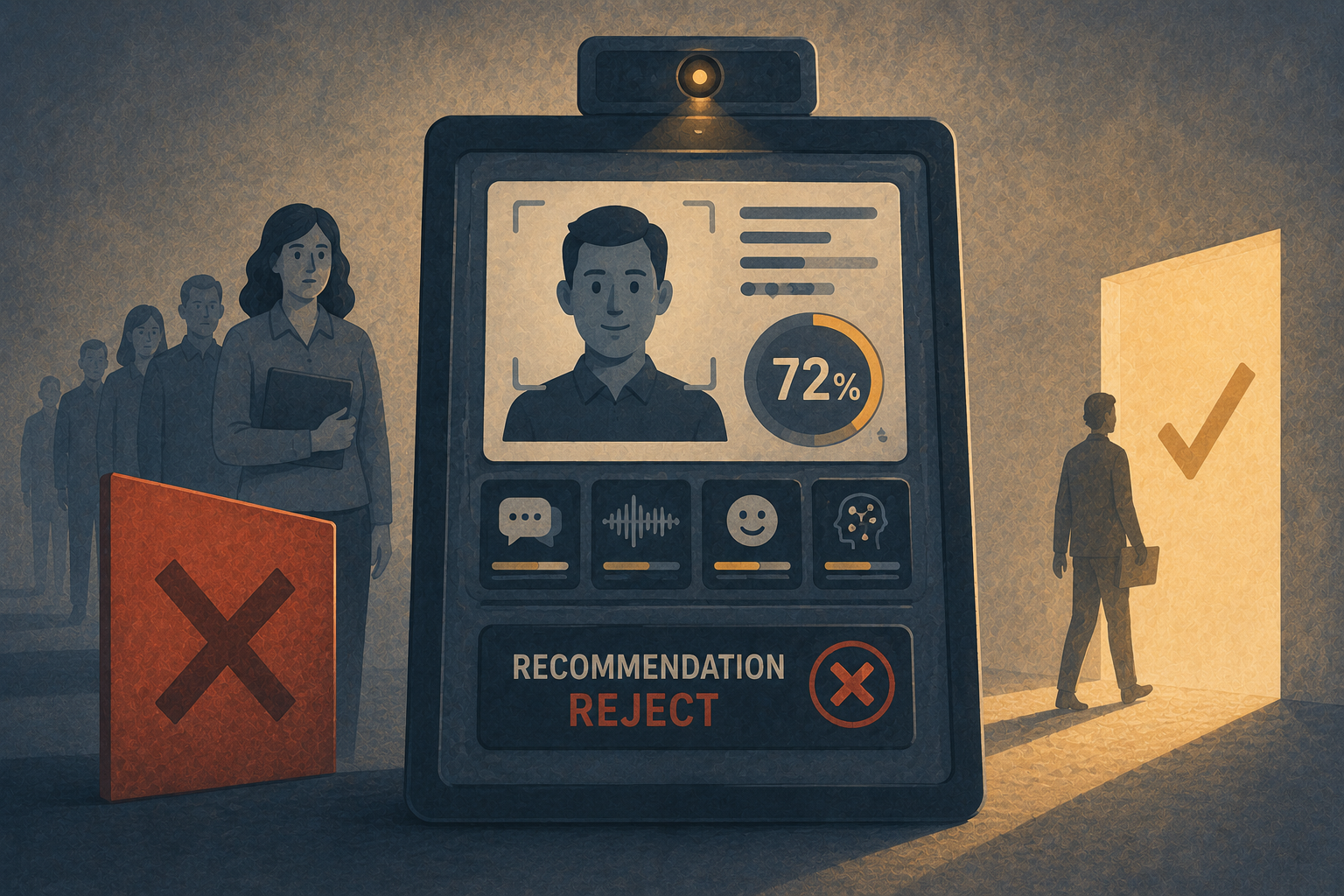
A federal court froze Colorado's landmark AI Act in April 2026, a DOJ-backed constitutional challenge is pending, and a replacement bill has cleared both chambers of the state legislature. The headlines are easy to read as a retreat from AI hiring regulation, but that reading is wrong, and it is a costly one.
The pause affects exactly one jurisdiction's enforcement calendar. It does not affect California, Illinois, New York City, or the federal anti-discrimination statutes that have governed hiring for decades.
If your organization uses an AI-driven video screener, a resume-ranking algorithm, or any automated tool that influences who advances in a hiring process, your compliance work is not on hold — the legal environment around that tool is more active right now than it was 12 months ago.
This is not really a post about Colorado, which is only the news peg. The real subject is the patchwork that surrounds it, and the specific exposure that structured video screening creates inside that patchwork.
What the Colorado Stay Actually Says
On April 27, 2026, a federal court paused enforcement of Colorado's SB 24-205, placing one of the country's most comprehensive state AI laws on hold while lawmakers reconsidered its timing and scope.
Under the court's order, Colorado will not initiate investigations or enforcement actions under the law — most recently set to take effect on June 30, 2026 — while the case remains stayed.
The legislative track adds further complexity. Colorado lawmakers introduced SB 26-189, which would repeal and replace the existing law with a narrower framework governing automated decision-making technology. The bill passed both the Colorado House and Senate before being sent to Governor Polis, who is expected to sign it.
What the stay does not do is equally important. The stay offers businesses a short-term reprieve from Colorado AI Act-specific enforcement activity, but it does not resolve whether the law will take effect as-is, be amended or replaced, or be enjoined on constitutional grounds.
In other words, one enforcement calendar paused while the surrounding landscape kept moving.
Three Jurisdictions That Did Not Pause
The employer watching the Colorado news and concluding that state-level AI hiring regulation is losing steam is reading the wrong signal. Three jurisdictions are actively governing AI in hiring right now — California through amended FEHA regulations, Illinois through the AI Video Interview Act and Human Rights Act amendments, and New York City through Local Law 144 — each with its own posture.
California
Regulations effective October 1, 2025 amended the existing framework under the California Fair Employment and Housing Act (FEHA) to apply to all employers in the state that use AI and automated decision systems in employment decision-making.
Those regulations provide that the use of such tools can violate California law if they discriminate against employees or applicants, either directly or through disparate impact, on the basis of protected characteristics.
The records retention obligation runs 4 years, and the anti-bias testing framework is active, with documentation of that testing serving as material evidence in any subsequent discrimination defense.
Illinois
Illinois became the first state to enforce AI transparency requirements in hiring, with its Artificial Intelligence Video Interview Act taking full effect in February 2026.
Employers using AI to analyze video interviews must now notify candidates, explain how the technology works, and obtain consent before proceeding.
The broader Illinois Human Rights Act amendments, effective January 1, 2026, extend this further by making it a civil rights violation for an employer to use AI in a manner that results in discrimination under the Illinois Human Rights Act. Unlike many AI statutes that focus on intent or process, these amendments center squarely on effect.
New York City
Local Law 144 of 2021 requires annual independent bias audits for any automated employment decision tool used to screen candidates within the city.
The enforcement picture there is complicated, but not in the direction employers might prefer: the New York City Department of Consumer and Worker Protection has committed to implementing most of the State Comptroller's recommendations, signaling a shift toward more rigorous oversight.
Employers should expect a more stringent enforcement phase, with increased investigations and the risk of daily penalties of up to $1,500 per violation per day.
The Federal Floor That Never Moved
State law is not the only exposure. The Equal Employment Opportunity Commission (EEOC) has made the employer liability framework clear at the federal level.
"The algorithm did it" is not a valid defense under Title VII of the Civil Rights Act.
As the agency sharpens its focus on technology-driven discrimination, employers should expect that position to be tested more aggressively in coming enforcement actions.
The vendor relationship does not change this calculus. The EEOC continues to prioritize algorithmic fairness, and employers remain fully liable under Title VII if their AI tools produce a disparate impact on protected groups, regardless of whether the tool was purchased from a vendor.
The litigation pipeline reinforces the point. The most closely watched AI hiring discrimination lawsuit in the country, Mobley v. Workday, reached a critical milestone in February 2026 when a federal court in California authorized notice to potential class members who alleged that Workday's AI screening software unlawfully filtered out job applicants based on age, race, and disability.
The court's decision to allow the case to proceed is notable because it treats the software vendor as an agent of the employer. If your vendor's tool discriminates, the legal exposure does not stop at your vendor's door.
Where Video Screening Sits in This Framework
Structured video screening occupies an especially exposed position inside the current legal landscape, for two related reasons.
It is explicitly named
California's regulations specifically identify tools that evaluate facial expressions and speech patterns in online interviews as covered automated decision systems. Illinois's Artificial Intelligence Video Interview Act was written for exactly this category of tool. New York City's Local Law 144 definition of an automated employment decision tool expressly contemplates video analysis.
The opacity problem is acute
A resume screener produces a rank or a score that can be examined. A video analysis tool often produces a rating derived from tone patterns or behavioral proxies that neither the employer nor the candidate can independently audit.
That opacity is not legally neutral. It creates a documentation problem when a regulator or a plaintiff asks the employer to explain why a candidate did not advance, and an employer who cannot explain their screener's reasoning is not in a defensible position under any of the three active frameworks above.
What Compliance Actually Requires Right Now
The following is not an exhaustive checklist. It is a baseline orientation for the employer who has not yet treated AI video screening as a regulated activity.
Map your tools. Every system that influences a hiring decision is potentially covered under California, Illinois, or NYC rules, depending on where your candidates are located. That mapping should include third-party video screening platforms, AI-scored asynchronous interviews, and resume processing tools that feed into a ranked list.
Obtain and document consent. Illinois and New York City both require candidate notice before an automated tool is used, and Illinois in particular requires explicit written consent, which cannot be buried in terms of service or a general application flow.
Understand your vendor's audit posture. In New York City, the employer has an independent obligation to ensure a bias audit has been conducted within the past 12 months, regardless of what the vendor claims. California's FEHA framework makes anti-bias testing evidence that supports an employer's defense — the absence of testing being evidence against them.
Retain records. California requires 4 years of automated decision system data, including inputs, outputs, criteria, and audit findings. Multi-state employers should treat the California standard as their floor.
Build a human review stage. None of the three active jurisdictions prohibit AI-assisted screening outright, but all of them are skeptical of processes where an AI output is the only thing standing between a candidate and rejection. A documented human review stage at a defined point in the funnel is a compliance architecture choice rather than a bureaucratic formality.
One Design Pattern That Holds Up
The architecture that fares best under all three active frameworks is one that keeps AI out of the advancement decision itself. Structuring screening around employer-defined, job-relevant challenges that candidates respond to directly, with human reviewers making advancement decisions, keeps the signal job-related, the process auditable, and the documentation complete.
That pattern can be built in-house, layered onto an existing ATS, or bought off the shelf — McCoy is one platform that implements it, but the logic of the post does not require McCoy, and an employer who applies the same principles to their existing toolchain reaches the same compliance posture.
A Practical Note on the Coming Months
Colorado's story is not over. Employers should continue to monitor this space and be prepared for the likely enactment of the replacement law and for potential further litigation over AI regulation in the state.
The replacement bill is narrower than its predecessor, but it still governs automated decision-making in employment contexts, and it proposes a new effective date of January 1, 2027.
The broader pattern is directional. California, Illinois, and New York City are not waiting for a federal standard to emerge — their frameworks are active, their enforcement agencies have documented compliance failures, and their definitions of covered tools are broad enough to include most commercial video screening products used today.
The compliance-minded employer's exposure no longer depends on whether the landscape continues to grow. It depends on whether their screening infrastructure was built to document its own behavior before a regulator asks.
This article is general commentary and does not constitute legal advice. Employers facing specific compliance questions should consult qualified counsel.
Works Cited
Hengesbaugh, Brian, et al. "Colorado Two-Step: Already Facing Potential Amendments, a Federal Court Pauses Enforcement of Colorado's Forthcoming AI Law." Baker McKenzie Connect on Tech, May 1, 2026. https://connectontech.bakermckenzie.com/colorado-two-step-already-facing-potential-amendments-a-federal-court-pauses-enforcement-of-colorados-forthcoming-ai-law/
Law and the Workplace. "Major Developments Put Colorado's AI Law on Ice Ahead of Implementation." Littler Mendelson, May 2026. https://www.lawandtheworkplace.com/2026/05/major-developments-put-colorados-ai-law-on-ice-ahead-of-implementation/
Manatt, Phelps & Phillips. "AI-Assisted Hiring Faces a New Compliance Landscape in 2026: California and Illinois Put Discriminatory Impact and Transparency Front and Center." Manatt, December 2025. https://www.manatt.com/insights/newsletters/employment-law/ai-assisted-hiring-faces-a-new-compliance-landscape-in-2026-california-and-illinois-put-discriminatory-impact-and-transparency-front-and-center
DLA Piper. "Critical Audit of NYC AI Hiring Law Signals Increased Risk for Employers." DLA Piper, January 30, 2026. https://www.dlapiper.com/en/insights/publications/2026/01/critical-audit-of-nyc-ai-hiring-law-signals-increased-risk-for-employers
Reddock-Wright, Angela. "AI-Driven Hiring Bias: The Next Frontier of EEOC Enforcement." AngelaReddockWright.com, February 27, 2026. https://angelareddock-wright.com/ai-driven-hiring-bias-the-next-frontier-of-eeoc-enforcement/